
Frederic Remington Rides with the Tenth
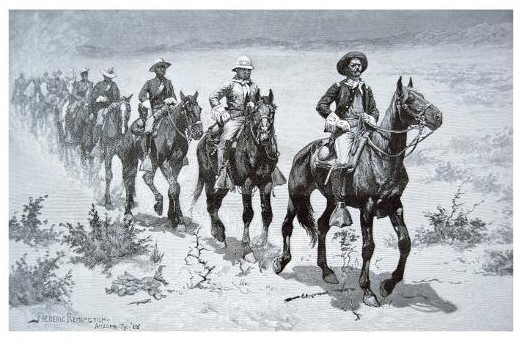
Long before the Tuskegee Airmen took to the skies in the 1940’s, another equally unique group of men took to the plains to wage war against the Indians and protect our National Parks – unique in that both groups of “warriors” were formed entirely of Black troops.
In 1866, an Act of Congress authorized the creation of two cavalry units and four infantry units. The consisted of the 9th and 10th Cavalry Regiments and the 38th, 39th, 40th and 41st Infantry. Made up of mostly former slaves these black units served in the post-civil war West. They were dispatched to help the army fight the Indians in the western territories and try to keep peace between the settlers and the Indians. The 38th thru the 41st were later merged to become the 24th and 25th Infantry.
These soldiers served at Wounded Knee and in Cuba with Teddy Roosevelt. They fought Crazy Horse and helped in the capture of Geronimo. The 9th and 10th Regiments patrolled from the Mississippi to the Rockies, from the Canadian border to the Rio Grande. They crossed the border into Mexico in pursuit of outlaws and Indians. Their duties included guarding the railroads and the workers of the Kansas and Pacific Railroads, help string miles of telegraph lines and guard the same, guard the stagecoaches, towns and the U.S. mail. They helped build forts and mapped large areas of the southwest. The Soldiers fought against the Cheyenne, Comanche, Apache and Arapahoe among others. They participated in campaigns against Victorio, Geronimo and Nana.
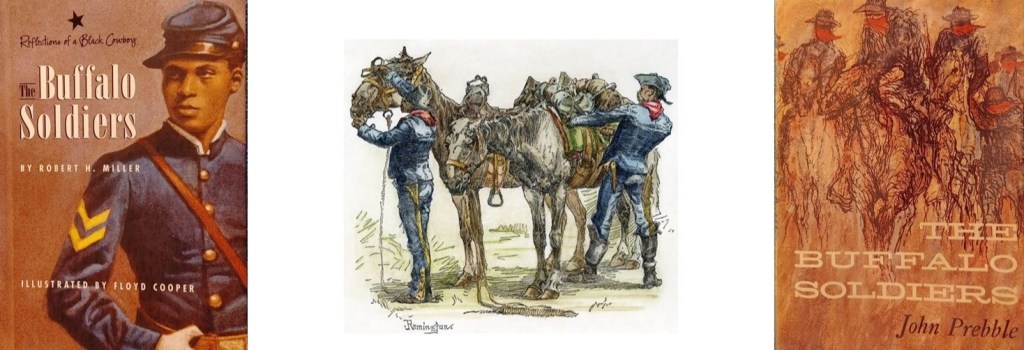
Though most of history lends to the belief that the soldiers became know as the “Buffalo Soldiers” thanks in part to the Indians who acknowledged their courage and bravery and associated their hair to that of their sacred buffalo, some do not believe the story. In a book published in 2001 and written by William A. Dobak and Thomas D. Phillips, The Black Regulars 1866-1898, Dobak and Phillips challenge the validity of the story. In part, they say that “…the expression gained wide circulation through Frederic Remington, who used it in the title of a magazine article in 1889.” They go on to say that the soldiers did not mention the term in letters about their daily life.
The article they are referring to is “A Scout with the Buffalo Soldiers” published in the April 189 issue of Century Magazine. This is the story of Remington’s observations of cavalry life while on patrol with the Tenth. However the name “Buffalo Soldier” came about they certainly earned it, giving them their own special place in history. The buffalo became a part of the military crest of the Tenth Cavalry.
For over twenty years the 9th and 10th Cavalry Regiments served in Montana, Texas, New Mexico, Arizona, Colorado and the Dakotas. Kit Carson and Wild Bill Hickok were among the white scouts for the Regiments. Many white officers were given commissions to serve with the Buffalo Soldiers and some refused including Lieutenant-Colonel George Armstrong Custer. It is ironic that the Buffalo Soldiers rescued Custer and his command when they were pinned down in an engagement.
Members of the 9th and 10th fought in the Spanish-American War and took part in the charge up San Juan Hill with Teddy Roosevelt.
In July of 1992, General Colin Powell dedicated a memorial to the Buffalo Soldiers at Fort Leavenworth, Kansa – the oldest fort west of the Mississippi.
To read more about the part the Buffalo Soldiers played in protecting our national parks, visit the Yosemite National Park website. Several years ago I had come across an article in my local newspaper about Park Ranger Shelton Johnson and contacted him. Check out the website here. Buffalo Soldiers – Yosemite National Park (U.S. National Park Service) (nps.gov)
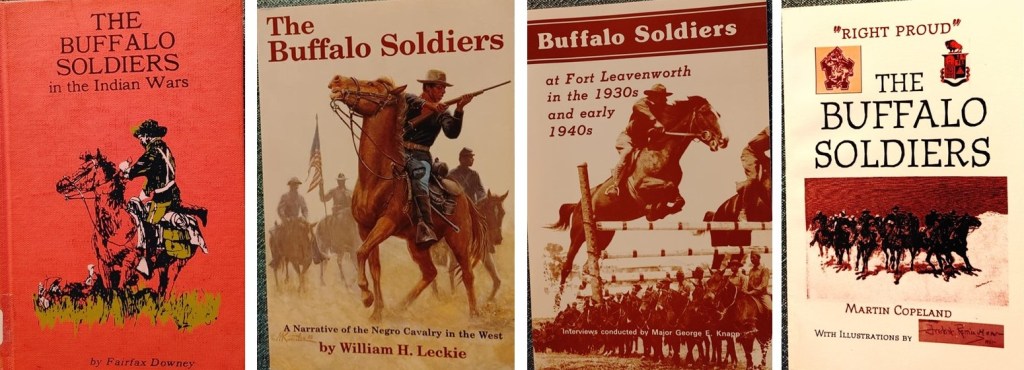
There are so many great books about the Buffalo Soldiers and here are just a few more pics from my library.
HAPPY READING!
Kathy

 About Frederic Remington